Chinese vs Western Wedding Traditions: A Side-by-Side Guide
If you're planning a cross-cultural wedding — or simply attending one — it helps to know how Chinese and Western wedding traditions actually line up. The two systems are not opposites; they're different structures built around the same goal: celebrating a couple in front of the people who matter.
This guide compares the ceremony, attire, gifts, guests, and lucky rituals side by side, then shows how modern couples combine both into one unforgettable day.
1. Ceremony structure
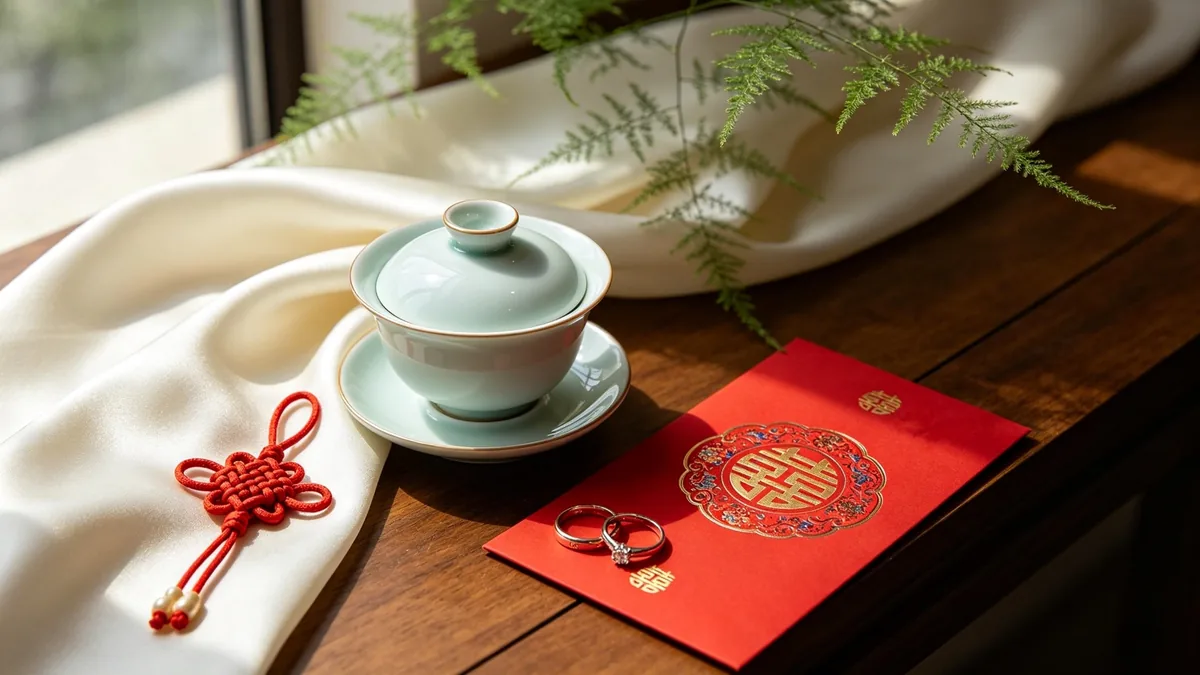
A Western wedding usually has one ceremony (church, outdoor, or courthouse) followed by a reception. A Chinese wedding centers on two events: the tea ceremony, where the couple honors parents and elders, and the banquet, the main celebration with a multi-course dinner.
In mainland China, families may hold separate tea ceremonies at the groom's and bride's homes. Overseas, most couples run one combined tea ceremony in the morning and a banquet in the evening — often with a Western ceremony in between.
2. Attire
- Western: a white gown and suit, often a second dress for the reception.
- Chinese: a red qipao or embroidered qun kwa for the tea ceremony, then a Western gown for the banquet — many brides change outfits two or three times.
See our qipao vs qun kwa guide to choose the right Chinese outfit.
3. Vows vs tea ceremony
The Western equivalent of the tea ceremony is the exchange of vows and rings — the public promise. In Chinese tradition, the equivalent moment is the tea ceremony: the couple serves tea to parents and elders, who drink it and give their blessing plus red envelopes. One is a promise to each other; the other is a formal joining of two families. Cross-cultural couples often do both — vows for the couple, tea ceremony for the families.
4. Gifts: registry vs red envelopes
Western weddings use a gift registry; Chinese weddings use cash in red envelopes. At hybrid weddings, both happen: a registry for convenience and red envelopes as the traditional standard. If you're unsure, red envelopes are always safe — see our amounts guide.
5. Guests, seating, and toasting
- Tables: Chinese banquets seat guests at round tables of 8–10, with the head table for the couple and families.
- Toasting: expect frequent toasts (干杯, gān bēi) and the famous "yam seng" shout at Southeast Asian Chinese weddings, versus the Western first dance and best-man speeches.
- Structure: the Chinese banquet is a long, multi-course meal where the couple circulates to toast each table; Western receptions mix dinner with dancing and speeches.
6. Lucky dates, numbers, and colors
Western tradition brings "something old, something new, something borrowed, something blue." Chinese tradition brings auspicious wedding dates (chosen with the help of a Chinese almanac or a fortune teller), the lucky number 8, red and gold everywhere, and the double happiness symbol 囍. Both traditions are about inviting good fortune — just with different vocabularies.
7. How couples combine both
- Morning: tea ceremony at the bride's home or the venue, in Chinese attire.
- Afternoon: Western-style ceremony — vows, rings, readings — often bilingual.
- Evening: banquet with round tables, toasts, a first dance, and a photo slideshow of both cultures.
- MC: a bilingual emcee explains each tradition so every guest understands what's happening.
8. Frequently asked questions
Can we do both Chinese and Western ceremonies in one day?
Yes — it's the most common format for cross-cultural couples: tea ceremony in the morning, Western ceremony in the afternoon, banquet in the evening.
Which comes first, the tea ceremony or the Western ceremony?
Usually the tea ceremony comes first thing in the morning, then the Western-style ceremony, then the banquet. Some couples reverse the order; what matters is planning the timing with your photographers.
Do guests give cash and a registry gift?
One or the other. Cash in a red envelope is the Chinese standard; if the couple also has a registry, choose one path and don't double up.
Is it okay to skip the tea ceremony?
It's the tradition families care about most. Skipping it can disappoint parents and grandparents, so talk to both families early — most couples find a shortened version works for everyone.
9. A typical hybrid wedding day
| Time | Event | Notes |
|---|---|---|
| Morning | Hair and makeup, then the tea ceremony | Chinese attire; both families present |
| Midday | Photo sessions | Couple, families, wedding party |
| Afternoon | Western-style ceremony | Vows, rings, bilingual readings |
| Evening | Banquet | Round tables, toasts, yam seng, first dance |
10. Managing family expectations
- Talk to both families early and list the must-haves: elders usually insist on the tea ceremony; the couple usually wants vows and a dance.
- Budget for two ceremonies — venues and photographers charge for the extra time.
- Let each family host the part they care about most; it reduces conflict and shares the cost.
- Agree on the length: a shortened tea ceremony plus a standard ceremony is a common compromise.
11. What guests from each culture should expect
- Western guests: round banquet tables, frequent toasts, red envelopes instead of a registry, and a longer dinner than usual.
- Chinese guests: a vows ceremony, first dance, speeches, and possibly a registry in addition to the banquet.
- Everyone: a bilingual program or MC so no one feels lost — this is the single best investment a hybrid wedding can make.
12. How to explain each ceremony to the other side
Most confusion at hybrid weddings comes from guests not knowing what's happening next. Give each side a one-paragraph cheat sheet: Chinese guests get a note that a Western ceremony means vows, rings, a first dance, and speeches — and that a registry may exist alongside red envelopes. Western guests get a note that the tea ceremony is the couple's way of honoring elders, that red envelopes replace registry gifts, and that toasts happen often (you can sip, you don't have to drain the glass). A bilingual program card at each seat does the rest.
13. Wedding vocabulary both sides should know
Bridesmaid and groomsman map roughly to 伴娘 and 伴郎; the banquet is 婚宴; the toast is 敬酒; the tea ceremony is 敬茶; the betrothal gifts are 过大礼; and the first dance has no traditional equivalent. When families use different words for the same moment, such as 改口茶 versus 敬茶, it helps to agree on one shared schedule card so the MC, photographer, and both families are reading from the same page.
14. What matters most at the end of the day
No couple remembers whether the seating chart was perfect or whether the first dance started on time; they remember who made both families feel included. A hybrid wedding succeeds when every guest understands why each moment matters, which is why the bilingual program and the warm explanations matter more than any single tradition. Plan both ceremonies generously, explain them clearly, and let the couple's own style tie the two cultures together.
15. Both traditions win when you plan together
The most successful cross-cultural weddings treat the two traditions as a conversation rather than a compromise. Ask each family what one moment they cannot imagine missing, build the day around those moments, and let the couple's personality fill the rest. When both sides see themselves in the celebration, the wedding becomes the family story everyone tells for years.
Get the complete Starter Bundle — $99
All four guides — tea ceremony, etiquette, bilingual scripts, and planning — plus six bonus resources. Save $77 vs buying separately.
See the Bundle Bilingual Script Kit — $49