How Much to Give in a Red Envelope: Chinese Wedding Gift Amounts
If you've been invited to a Chinese wedding, the first question is usually not what to wear — it's how much money to put in the red envelope. Cash is the standard wedding gift across Chinese communities, and the amount you choose sends a clear message about your relationship and your respect for the family.
There is no single correct number, but there are strong conventions: lucky digits, regional ranges, and a few numbers you should avoid. This guide gives concrete amounts for China, Singapore, Malaysia, Hong Kong, and overseas Chinese weddings, plus the rules for handing the envelope over gracefully.
1. Why cash, not gifts
In Chinese culture, a wedding gift is practical first: the couple is starting a household, and a banquet seat costs real money. Giving cash in a red envelope (红包 / ang bao) lets the couple cover their wedding costs and start married life without a pile of duplicate toasters.
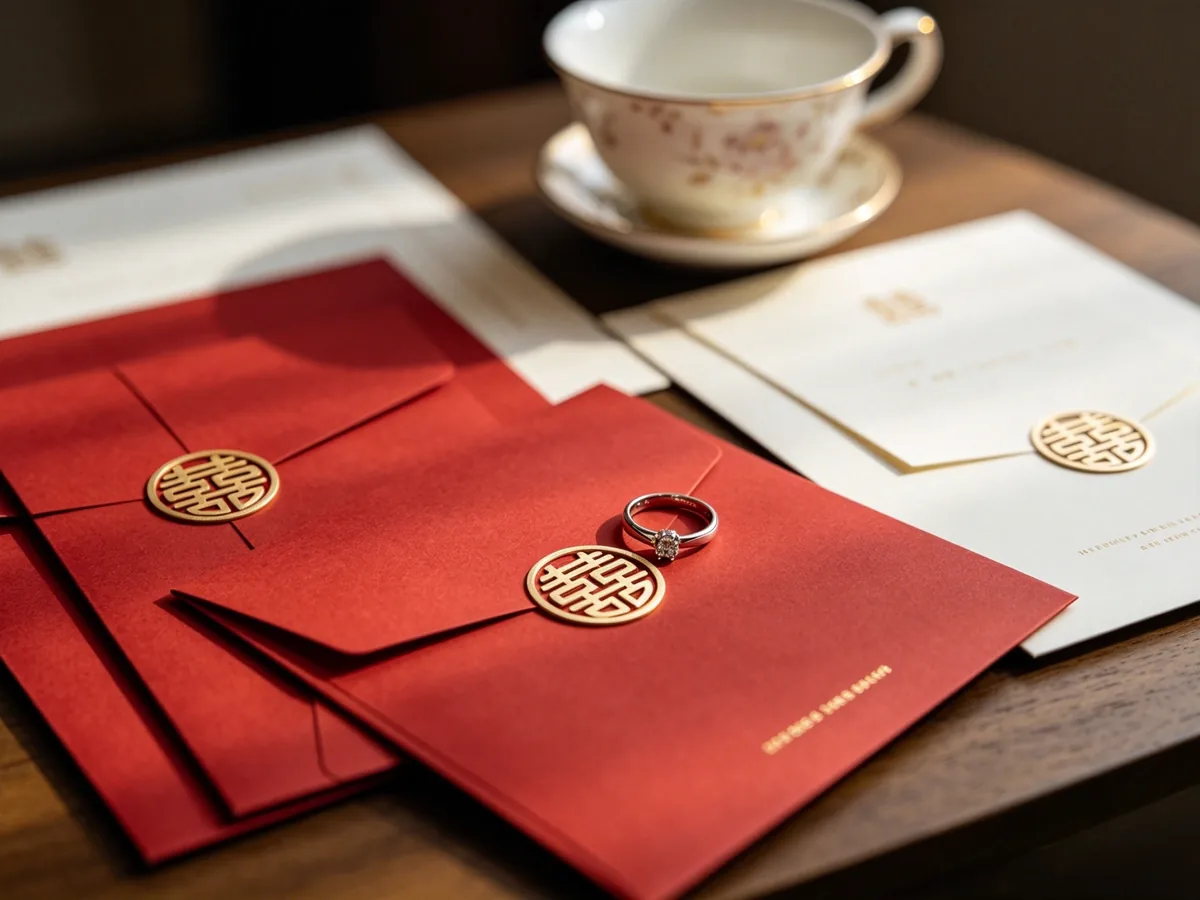
The red envelope itself is part of the gift — red symbolizes joy and good fortune, so the packaging is as important as the amount. An odd-looking amount or a plain white envelope can unintentionally signal disrespect, which is why the numbers below matter.
2. How much to give
Amounts vary by city, venue, and relationship. As a rule of thumb, your gift should roughly cover your share of the banquet in expensive cities (Singapore and Hong Kong especially) and be generous relative to your relationship elsewhere.
| Where | Friend / colleague | Close friend / family | Immediate family |
|---|---|---|---|
| Mainland China (RMB) | 200–600 | 600–2,000 | 2,000–10,000+ |
| Singapore (SGD) | 50–100 | 100–300 | 300–1,000+ |
| Malaysia (MYR) | 50–150 | 150–500 | 500–2,000+ |
| Hong Kong (HKD) | 500–1,000 | 1,000–3,000 | 3,000–10,000+ |
| US / UK / Canada (USD / GBP / CAD) | $50–100 | $100–300 | $300–1,000+ |
- Adjust for your city. First-tier cities and premium venues mean higher amounts.
- Give as a group. Colleagues and friends often pool money into one envelope — perfectly normal, just list everyone's names.
- Match your relationship, not your ego. A thoughtful amount for a colleague is different from a sibling's wedding.
3. Lucky numbers and what to avoid
- 8 (发, fa) — sounds like "wealth". 88, 288, 888 are all excellent.
- 9 (久, jiu) — sounds like "long-lasting", perfect for weddings. 99 or amounts ending in 9 are popular in southern China.
- 6 (顺, shun) — smooth sailing; 66 and 666 are common.
- 168 — "all the way to prosperity" (一路发).
4. Who gives what
- Guests give red envelopes at the reception, usually at a gift table or to a designated relative.
- Parents and grandparents give the biggest envelopes — often with gold jewelry — during the tea ceremony.
- The couple gives smaller red envelopes to bridesmaids, groomsmen, page boys, and children as thanks.
- Bosses and mentors are often generous, but never feel obligated to match a wealthier guest.
5. How to hand over the envelope
- Use crisp, new notes — wrinkled money looks careless.
- Write your name on the envelope (front or back) so the couple can keep track; they record who gave what.
- Hand it over with both hands, or place it quietly in the gift box — don't make a show of it.
- Never open someone's envelope in public, and never comment on amounts.
6. Frequently asked questions
Is $100 enough at a US or UK Chinese wedding?
Yes for a friend or colleague; $150–300 is more common for close friends and family. If the banquet is at a premium venue, aim closer to your per-seat cost.
Can I give $88 or $99?
Absolutely — 8 and 9 are both lucky. 88 means double fortune, and 99 means "long-lasting" (especially popular in southern China).
Should I avoid giving $40 or $400?
Yes. 4 sounds like "death" in Chinese, and amounts containing 4 are widely avoided at weddings.
Can I give a physical gift instead of cash?
Cash is the standard for guests. Physical gifts are reserved for elders (gold and jewelry at the tea ceremony) or for couples who explicitly set up a registry — if they did, follow it.
7. Real-world scenarios
- A colleague's wedding in Singapore: SGD 60–88 comfortably covers a standard hotel banquet seat.
- A close friend's wedding in the US: $150–250 plus a card is typical.
- A sibling's wedding in mainland China: RMB 5,000–20,000, often alongside a physical gift.
- Your boss or mentor: generous but not competitive — $200–500 is safe.
- You're in the wedding party: your main contribution is time; a modest red envelope is expected, not an extravagant one.
8. Regional customs beyond the amount
- Singapore and Malaysia: the ang bao should roughly cover your seat cost; giving less at a luxury hotel looks careless.
- Hong Kong: lai see is also given to banquet staff and children, and amounts are expected to cover the table.
- Mainland China: WeChat red packets are widely used for small amounts; larger gifts stay physical.
- Overseas: a registry may coexist with red envelopes — follow the couple's lead.
9. Mistakes to avoid
- Using a white envelope or worn notes.
- Amounts with 4 anywhere, or exact 400-style figures.
- Opening or discussing amounts in public.
- Forgetting your name on the envelope — the couple records who gave what.
- In Singapore or Hong Kong, giving less than the banquet seat costs.
10. Quick-reference card
| Relationship | Suggested range | Lucky options |
|---|---|---|
| Friend / colleague | $50–100 (or SGD 50–88) | $66, $88 |
| Close friend / family | $100–300 | $168, $288 |
| Immediate family | $300–1,000+ | $888, $999 |
11. On a tight budget?
A smaller amount is never rude if it's thoughtful. A friend on a student budget giving $38 or SGD 28 with a warm card is normal — what looks careless is a large restaurant bill's worth of food consumed with a token envelope in Singapore or Hong Kong. If money is genuinely tight, skip the hotel-banquet weddings' seat-covering pressure by RSVPing early, or offer help instead: driving guests, taking photos, or assisting with setup are remembered warmly.
12. When the couple asks for no gifts
Some couples explicitly say "no red envelopes" — usually couples who already live together or who want to keep things simple. In that case, don't give cash anyway; a card with a heartfelt note, or a small contribution to a honeymoon fund they've set up, is the graceful middle path. If you simply must give, keep it small and personal.
13. Putting it together
The golden rules fit on one hand: choose a lucky number that fits your relationship, cover your banquet seat in Singapore and Hong Kong, write your name on the envelope, use crisp new notes, and never discuss amounts. Everything else, such as the exact figure, the timing, and whether to add a card, is flexible and forgivable. Couples remember the thought, not the math.
Get the complete Wedding Etiquette Guide — $39
36 pages covering red envelopes, gifts, dress codes, seating, and tea ceremony etiquette — with a printable cheat sheet.
See the Guide Starter Bundle — $99