Chinese Wedding Gift Etiquette: What to Give (and What Not to)
At a Chinese wedding, the gift you give — and how you give it — is part of the ritual. Cash in a red envelope remains the standard, but there are also gifts that are considered deeply unlucky, and a few rules about wrapping and timing that outsiders rarely know.
Whether you're a guest, a close friend, or a future in-law, this guide tells you what's safe to give, what's guaranteed to cause awkwardness, and how to present anything with respect.
1. Cash is king
In Chinese communities worldwide, the wedding gift is a red envelope of cash. It's practical — the couple needs to cover the banquet — and symbolic, because red envelopes carry blessings. If you're unsure what to give, cash in a red envelope is never wrong.
For exact amounts, lucky numbers, and regional ranges, see our red envelope amounts guide.
2. Cash vs physical gifts
- Guests: cash is standard. Physical gifts are acceptable only if the couple set up a registry (common at overseas Chinese weddings).
- Elders: gold jewelry, jade, or meaningful heirlooms are traditional at the tea ceremony, usually alongside a large red envelope.
- Close friends: a small physical gift in addition to cash is a warm touch — but the cash remains the main gift.
3. What not to give
- Clocks — "giving a clock" (送钟, sòng zhōng) sounds like "attending a funeral" (送终). Never.
- Umbrellas — 伞 (sǎn) sounds like "to separate" (散).
- Pears — 梨 (lí) also sounds like "separation".
- Green hats — implies infidelity in Chinese culture.
- Sharp objects — knives and scissors suggest "cutting ties".
- Shoes — 鞋 (xié) sounds like "evil" or "rough".
- Mirrors and white flowers — associated with funerals.
4. How to present gifts
- Wrap in red, gold, or pink — never white or black wrapping paper.
- Give with both hands and a small bow; receive thanks without making a scene.
- For cash, use a proper red envelope (with 囍 if possible) and write your name on it.
- Timing: hand over gifts at the reception or gift table; tea ceremony gifts go to elders during the ceremony.
5. Tea ceremony gifts
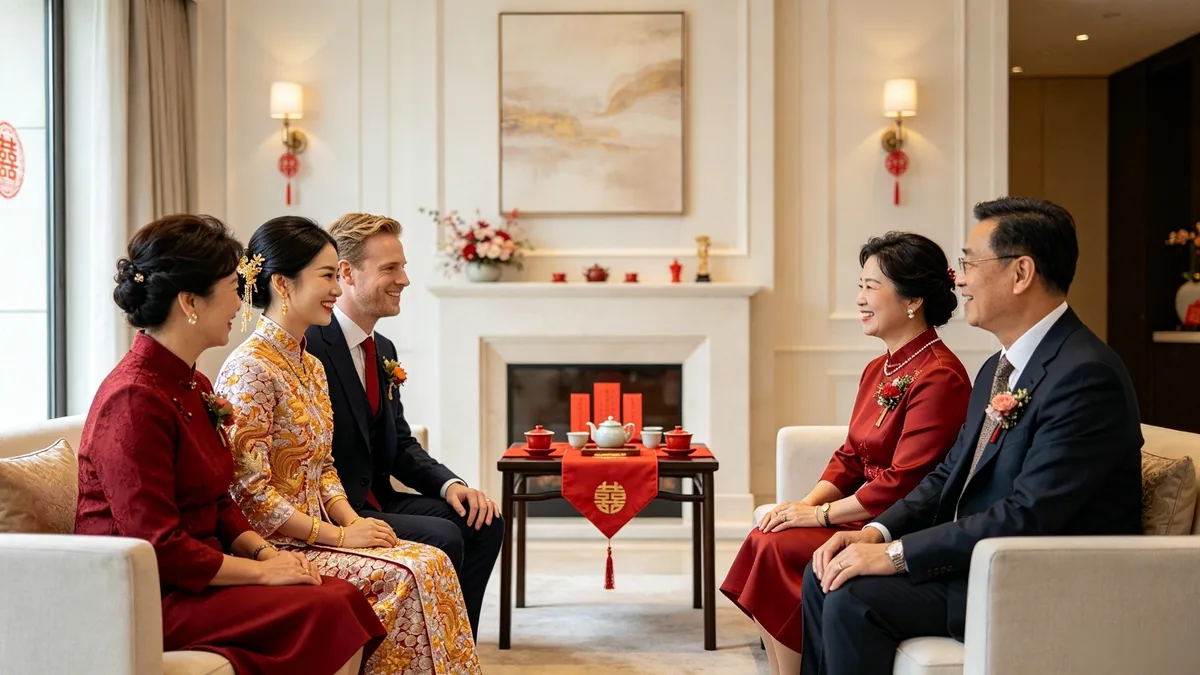
During the tea ceremony, elders give the couple red envelopes, gold jewelry, or jade as a sign of acceptance and blessing. If you're a new member of the family, this is where the meaningful gifts happen — and the amounts are typically much larger than a guest's gift. Parents and grandparents usually coordinate so the couple receives a memorable set of jewelry and envelopes.
6. Frequently asked questions
Can I give a gift from the couple's registry?
Yes — if a registry exists, follow it. It usually appears alongside cash as the standard at overseas Chinese weddings.
Is wine or alcohol a good gift?
Yes, especially high-quality baijiu or wine — always in pairs (two bottles), since good things come in twos. Never give a single bottle.
Can I give money through WeChat or a banking app?
It's increasingly common in mainland China, using the app's red packet feature so the amount stays semi-private. For older guests and formal weddings, a physical red envelope is still preferred.
What if I already bought something they might not want?
Add a warm card and a small red envelope with a modest cash amount — the combination covers both traditions and never looks wrong.
7. If you're in the wedding party
- Bridesmaids and groomsmen usually give a gift plus a modest red envelope — the time you've already given is part of the gift.
- At the door games (堵门), the groom's side hands small red envelopes to the bridesmaids; have a stack ready if you're organizing.
- Helpers and family members who worked the day often receive a small red envelope as thanks — the couple typically arranges this.
8. Remote and digital giving
- Wire or bank transfer: send the amount with a congratulatory message; use a lucky number when possible.
- Digital red packets: WeChat, PayNow, or Venmo versions of the red packet work for smaller amounts.
- Mailing a gift: ship early, avoid glass or fragile items, and use plain packaging — wrapped gifts can sit in customs for weeks.
- Always confirm you have the couple's current address or payment details; don't send money to an unverified account.
9. Common gift mistakes
- White or black wrapping paper.
- A single bottle of wine or alcohol — always give in pairs.
- Forgetting your name on a red envelope.
- Giving at the wrong moment (for example, during the tea ceremony as a guest).
- Asking "how much did you give?" — never.
10. Etiquette quick list
- Wrap everything in red, gold, or pink.
- Give with both hands.
- Pair everything: two bottles, two items.
- Avoid clocks, umbrellas, pears, knives, shoes, and mirrors.
- Write your name on cash envelopes.
11. Why the taboos exist
Chinese gift taboos are almost all homophones. A clock (送钟, sòng zhōng) sounds like "attending a funeral" (送终); an umbrella (伞, sǎn) sounds like "to separate" (散); a pear (梨, lí) sounds like "separation" too; and shoes (鞋, xié) sound like "rough" or "evil". None of these are about the object's use — they're about the unlucky sound of the word. That's why even a beautiful watch should be avoided, and why a thoughtful gift is usually judged first by what it sounds like, not what it costs.
12. A note for same-generation friends
If you're a close friend, the pressure to "get it right" is lower than you think. Couples today understand that their international friends may not know red envelope culture — a warm card, a small gift from your own culture, or simply showing up with energy and helping with photos is remembered far more than a perfect envelope. The etiquette rules matter most to elders; for peers, sincerity beats protocol.
13. When to give: timing and delivery
Guests hand over envelopes at the reception, at the gift table, or to a designated collector, not during the tea ceremony and not in the middle of dinner. Wedding-party members typically collect the door-game envelopes in the morning and hand everything to the couple at night. If you are mailing a gift, aim for it to arrive at least a week before the wedding, and include a note with your name so the couple's record stays accurate.
14. The summary card
Cash in a red envelope, both hands, your name on the back, lucky numbers only, nothing white or black, no clocks, umbrellas, pears, knives, shoes, or mirrors, and pair anything physical in twos. If you remember those five lines, you'll handle ninety percent of Chinese wedding gift etiquette correctly, and the remaining ten percent is covered by being warm, humble, and genuinely happy for the couple.
15. Etiquette serves the relationship
Rules exist so that a gesture of goodwill never lands as an insult, but the gesture itself is what matters. A modest red envelope with a sincere card, given with both hands and a warm smile, outranks an expensive gift delivered coldly. Keep the rules in mind, keep your heart in the gesture, and you will always be remembered well.
Get the complete Wedding Etiquette Guide — $39
Gift do's and don'ts, red envelopes, dress codes, seating, and tea ceremony etiquette — with a printable cheat sheet.
See the Guide Starter Bundle — $99